Square Wave (Incremental)
- TTL (RS-422)
- HTL (Push-Pull)
- Open Collector (NPN/PNP)

SAS Middle East FZC
German engineering, built in the UAE
SAS IntelliLink® Encoder Hub NEW
The SAS IntelliLink™ Encoder Hub is the multi-axis fiber path — not a single-axis protocol converter. It digitizes encoder feedback at the machine and sends it over duplex fiber to the Master Unit (ILEM) at your CNC cabinet: 2–5 encoders per string, up to 4 strings / 20 axes, up to 500 m, EMI/RF immune with 1:1 port mapping. Custom-built to axis count, protocol pair and fiber layout. Need only to convert one encoder protocol on a short run? Use the Encoder Bridge instead.
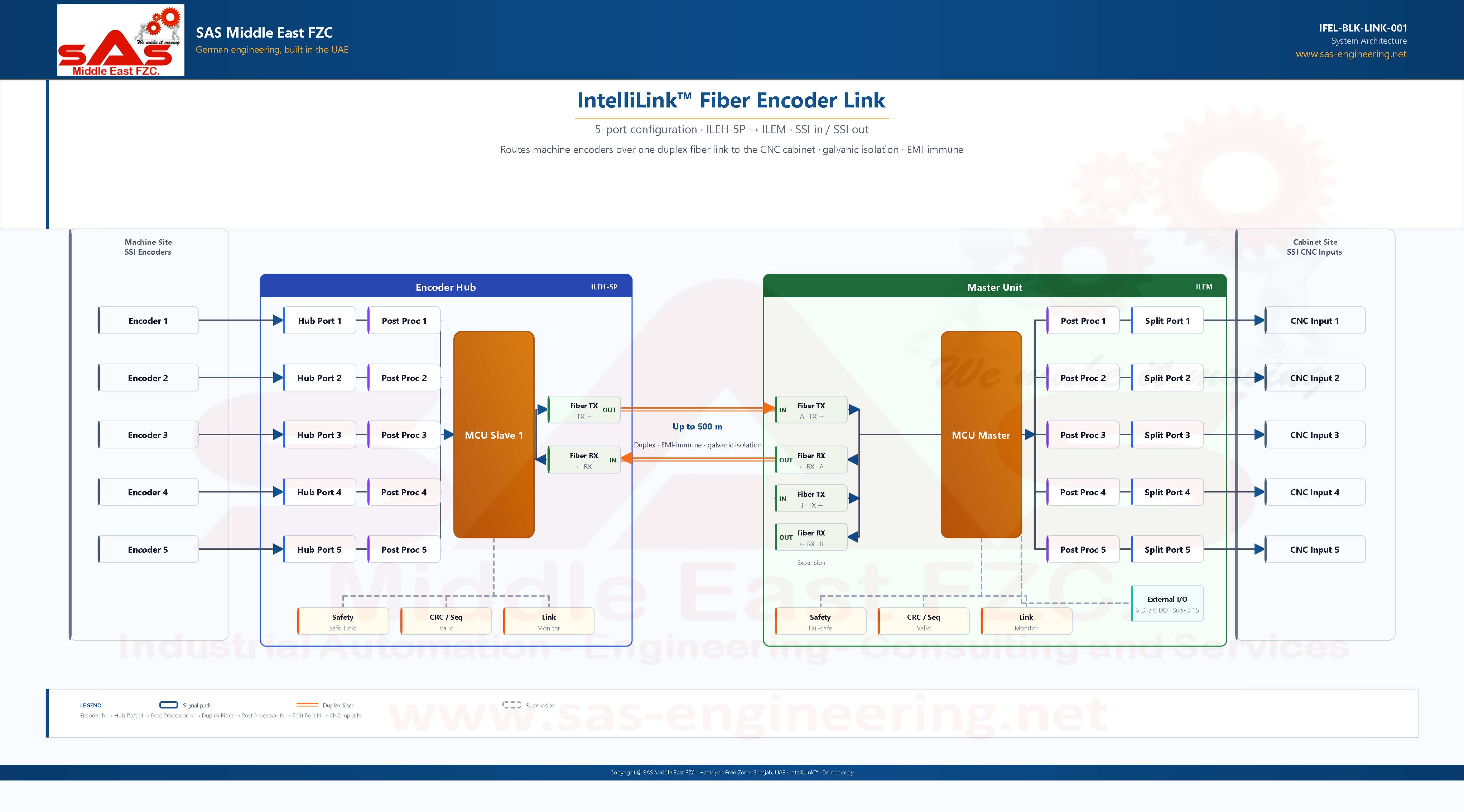
System Architecture
IFEL-BLK-LINK-001
2–5 per string
ILEH-2P through ILEH-5P hub variants
Up to 4 strings
Expandable per Master Unit (ILEM)
Custom-built
Engineered, wired, and tested per installation
The Pitch
Relocating a CNC cabinet? Fighting EMI, VFD harmonics, welding noise, or ground-loop drift on long copper encoder homeruns? Each SAS IntelliLink™ Encoder Hub string replaces those fragile cable paths with one duplex fiber run — electrically silent between machine and cabinet — while keeping every axis mapped 1:1 from encoder to CNC feedback input. Need more axes later? Add fiber strings to the same Master Unit without re-engineering the cabinet side.
No electrical signal travels the distance. Light carries your encoder data on each string. No conducted interference, no ground potential difference across the link, and no coupling from nearby power or RF sources on the fiber run itself. Scale from a compact 2-axis hub to four strings on one Master Unit as your production line grows.
What You Get
| At the machine | Over the distance | At the cabinet |
|---|---|---|
| Encoder Hub (ILEH) 2–5 encoders per string |
One fiber string — up to 500 m EMI and RF immune, galvanic isolation |
Master Unit (ILEM) Up to 4 strings · matched CNC outputs |
| Panel-mounted at each machine or line section | Each string is an independent galvanic-isolated link | Aggregates up to 4 hub strings in one cabinet |
| ILEH-2P, ILEH-3P, ILEH-4P, or ILEH-5P per string | EMI and RF immune · galvanic isolation per string | 8–20 total axes (4 × 2–5 encoders) |
Why Integrators Choose IntelliLink
VFD switching, weld fields, and RF sources along the run cannot corrupt encoder feedback on the link.
Machine earth and cabinet earth are electrically decoupled. Ground loops stop at the transceiver.
Each Encoder Hub string multiplexes 2–5 encoder axes onto one duplex fiber. Less copper, less conduit, less commissioning risk per machine.
Encoder N → Hub Port N → Split Port N → CNC Input N. No field remapping.
CRC/sequence validation, link monitoring, and safety supervision on both units.
Each ILEM accepts up to four independent fiber strings. Start with one Encoder Hub today; add strings as you add machines, gantries, or line sections — without replacing the cabinet-side master.
Standard link supervision on both units. Fail-safe and fully redundant system configurations are manufactured on request for safety-critical and high-availability applications.
Custom-built, wired, and commissioned by SAS Middle East FZC in Sharjah — local engineering support for integrators across Dubai, Abu Dhabi, and the GCC.
EMI, RF & Galvanic Isolation
| Problem on copper encoder cables | IntelliLink answer |
|---|---|
| VFD / servo drive switching noise | EMI and RF immune on the link |
| Welding, EDM, or heavy-motor plant noise | EMI and RF immune — unaffected by plant noise along the run |
| Ground loops between machine and cabinet | Galvanic isolation — no common return path on the link |
| Voltage potential difference over distance | Galvanic isolation — machine and cabinet sites electrically independent |
| Cable routing near power trays or RF sources | EMI and RF immune — tolerates harsh routing where copper cannot |
How It Works
Encoder N → Hub Port N → Post Processor N → Fiber → Post Processor N → Split Port N → CNC Input N
That is the entire contract. What you wire at the machine is what the CNC sees at the cabinet — same port number, every time.
Two Units, One System
Mounts at the machine or line section. Encoders connect to Hub Ports matched to your signal type. Each string supports 2–5 axes (ILEH-2P … ILEH-5P). Each axis is processed locally, then transmitted over its dedicated fiber string. Safety hold, CRC/sequence validation, and link monitoring run continuously on every hub.
Mounts in the CNC or PLC cabinet. Receives up to four fiber strings, restores each axis, and drives Split Ports to CNC Inputs. External status I/O (6 DI / 6 DO) for LINK_OK, fault, and inhibit integration across all connected strings.
Scalable Encoder Hub Architecture
Size each Encoder Hub string to the machine in front of it — from 2-axis lathes to 5-axis machining centers. The Master Unit at the cabinet aggregates up to four strings, giving you a clear growth path from a single hub installation to a multi-machine line without changing the core architecture.
| Configuration level | What you deploy | Typical encoder capacity |
|---|---|---|
| Single string | 1 × ILEH + 1 × ILEM (1 fiber string) | 2–5 encoder axes |
| Dual string | 2 × ILEH + 1 × ILEM (2 fiber strings) | 4–10 encoder axes |
| Triple string | 3 × ILEH + 1 × ILEM (3 fiber strings) | 6–15 encoder axes |
| Full Master Unit | 4 × ILEH + 1 × ILEM (4 fiber strings) | 8–20 encoder axes |
Each string maintains strict 1:1 mapping: Encoder N on that hub → Hub Port N → Split Port N → CNC Input N. Strings are engineered independently — one string can be SSI-dominant while another carries Sin/Cos or EnDat, depending on your machine mix.
At a Glance
| System name | SAS IntelliLink™ Encoder Hub / Fiber Encoder Link (IFEL) |
| Machine unit | IntelliLink Encoder Hub — ILEH-2P … ILEH-5P (per fiber string) |
| Cabinet unit | IntelliLink Encoder Master — ILEM (up to 4 fiber strings) |
| Encoders per string | 2–5 axes — fixed port count at factory per hub |
| Strings per Master Unit | Up to 4 expandable fiber strings |
| Maximum system capacity | 8–20 encoder axes (4 strings × 2–5 axes) |
| Fiber link | 1 × duplex per string, up to 500 m each |
| Expansion | Add ILEH strings to existing ILEM as machines or line sections grow |
| Status I/O | 6 DI / 6 DO (fail-safe integration) |
| Port mapping | Strict 1:1 — no field remapping |
| Protocol selection | Client choice per port — any supported input to any supported output |
| Link immunity | EMI and RF immune · galvanic isolation |
| Fail-safe / redundancy | Available on request — engineered per application |
Aerospace & Precision Manufacturing
5-axis structural machining — wing spars, fuselage fixtures, and large-bed titanium/aluminum parts where encoder fidelity drives tolerance stack.
High-precision turning, grinding, and drilling cells where feedback must stay clean across a remote control cabinet.
Assembly, test, and qualification rigs needing galvanic isolation and supervised multi-axis feedback for high-reliability builds.
Cabinet remote from the spindle area; fiber replaces noise-prone long encoder homeruns on gantry and portal machines.
Galvanic isolation between moving structure and control rack for predictable feedback in R&D and production verification.
Fail-safe and redundant IFEL configurations on request for safety-critical and qualification-driven programs.
Ideal Applications
Retrofit projects where the control cabinet moves away from the machine while encoders remain at the machine.
AHU, cleanroom, process HVAC, and building-services plants where encoder feedback must cross distance without EMI pickup or ground loops.
Pumping stations, treatment plants, and district utility skids with remote PLC cabinets and field-mounted drives.
VFD plants, welding bays, EDM, aluminum smelting, and RF-dense production floors.
Conveyor lines, palletizers, and automated storage systems with distributed motors and remote control panels.
Facilities where earth-potential differences between machine and cabinet cause drift or faults.
Heavy process lines with long cable runs, high motor noise, and control rooms separated from the production floor.
Milling, turning, laser, press, and positioning systems needing 2–5 feedback paths per machine — or multiple machines feeding one Master Unit via separate fiber strings.
Protocol Selection
Each axis port is configured independently at order time. Select any supported encoder input at the machine (ILEH) and any supported CNC output at the cabinet (ILEM). Every input can be paired with every output — not limited to like-for-like matching.
All vs all: the same 26 protocols on ILEH input and ILEM output. Port 1 can be SSI → EnDat 2.22 while Port 2 is 1 Vpp → TTL (RS-422) — you define the combination; SAS engineers and builds it.
| Example port configuration | ILEH input (machine) | ILEM output (cabinet) |
|---|---|---|
| Like-for-like | SSI | SSI |
| Protocol conversion over fiber | 1 Vpp | TTL (RS-422) |
| Absolute in, absolute out | BiSS-C | EnDat 2.2 |
| Legacy incremental | HTL (Push-Pull) | SSI |
| Current-loop analogue | 11 µA | TTL (RS-422) |
| OEM serial | Fanuc Serial | HIPERFACE DSL |
| Fieldbus out | SSI | EtherCAT |
These are examples only. Any supported input paired with any supported output is available — specify your combination per port when ordering.
Encoder Hub FAQ
Short answers engineers ask before sizing a multi-axis fiber link for CNC retrofit or cabinet relocation.
2–5 per fiber string (ILEH-2P … ILEH-5P). Port count is fixed at the factory for that hub.
Up to 4 fiber strings on one ILEM — 8–20 axes total depending on hub mix.
Up to 500 m duplex fiber per string between Encoder Hub and Master Unit.
Fiber is EMI and RF immune with galvanic isolation — VFD and welding noise stay off the feedback path.
Hub = multi-axis over fiber. Bridge = one encoder, protocol X→Y on short copper. Same protocol catalog.
Any supported in → any supported out per port (26-protocol IntelliLink catalog, including EnDat and Fanuc Serial).
No — custom-built, wired and tested per machine. Fail-safe / redundant builds on request.
Yes — add hub strings up to four on the same Master. Expansion path engineered at order time.
In the plant
New watermarked photography for the fiber encoder hub story — long runs, cabinet master and noisy electrical environments.


FAQ
Practical sizing answers — from Sharjah, for CNC and automation plants in the UAE and GCC.
When you have multiple axes, long cable runs, or electrical noise that corrupts copper encoder lines. The Hub digitizes feedback at the machine and carries it over duplex fiber to the CNC cabinet — up to 500 m per string and up to 20 axes on one Master Unit. Use the Encoder Bridge when you only need one encoder protocol converted on a short copper run.
Hub = multi-axis over fiber (distance, EMI immunity, galvanic isolation). Bridge = single-axis protocol converter (X in / Y out, optional dual output). Same IntelliLink 26-protocol catalog. Many plants use both.
Each string carries 2–5 encoders (ILEH-2P through ILEH-5P). One Master Unit accepts up to 4 fiber strings (8–20 axes total). Distance: up to 500 m duplex fiber per string between hub and master.
Yes. Duplex fiber is EMI and RF immune with galvanic isolation between machine and cabinet. VFD harmonics, welding fields and ground-loop differences cannot corrupt encoder data on the fiber run.
Any supported input paired with any supported output per port — the same 26-protocol IntelliLink catalog as the Encoder Bridge (including EnDat 2.1/2.2/2.22, Fanuc Serial, SSI, ABZ and fieldbus options). Specify the combination per port when ordering.
No. Each system is custom-built, wired and tested by SAS for your axis count, protocol pair, fiber layout and connectors. Fail-safe and redundant builds are available on request. Start with the Encoder Hub configurator.
Yes. Start with one fiber string and add hubs up to the four-string limit on the same Master Unit. SAS engineers the expansion path at order time so cabinet-side wiring stays predictable.
Yes. SAS Middle East FZC is based in Hamriyah Free Zone, Sharjah. We survey, engineer and commission fiber encoder hubs on site across the UAE and GCC.
Use the Encoder Hub configurator or Request a technical proposal. Include axis count, encoder protocols, approximate fiber distance and site. We typically reply within 24 hours.
Need an answer for your site? Request a technical proposal — we typically reply within 24 hours.
Tell us your machine type, encoders per string (2–5), number of fiber strings needed (1–4), estimated fiber distance per string, CNC model, and EMI/grounding constraints — or use the Encoder Hub Configurator to build your specification and submit directly.
Email
info@sas-engineering.net (Technical inquiries)
sales@sas-engineering.net (Sales inquiries)
Location
Hamriyah Free Zone
Sharjah, UAE
SAS IntelliLink™ Encoder Hub
Custom-built, engineered and tested by SAS Middle East FZC per installation.