
SAS EOAT Engineering
Custom end-of-arm tooling engineered for your robot, part and cycle time.
SAS EOAT Engineering delivers project-based custom end-of-arm tooling (EOAT) from concept through production build. We design pneumatic, electric and vacuum grippers, assembly tools and quick-change interfaces for ABB, KUKA, FANUC, Universal Robots and other ISO 9409 platforms — including applications in food processing, packaging, glass handling and agriculture/turf. Worldwide delivery from our UAE engineering hub with GCC on-site support when you need it.
Improved EOAT Capabilities
Expanded robotics tooling range
CAD & FEA
SolidWorks / Fusion 360
Quick-change
Multi-tool cells
Force sensing
Delicate handling
Engineering & Design
CAD, simulation and drawings before the first part is machined.
Every EOAT build starts in engineering — 3D models, tolerance stacks, pneumatic layouts and FEA on critical structures. Drawings and BOMs are issued for prototype and production builds with FAT criteria defined up front.

EOAT Capabilities
Robot gripper and end-of-arm tooling designed, built and tested by SAS engineers.
Our expanded EOAT engineering range covers mechanical design, actuation, sensing and integration with robot programs and safety systems.
Custom Gripper Design
Two-finger, three-finger and adaptive grippers; parallel and angular jaws; soft-touch fingers for fragile parts; custom finger geometry from your CAD or sample parts.
Vacuum & Pneumatic EOAT
Cup layouts, venturi and centralized vacuum, multi-zone switching, blow-off and part-present sensing for pick-and-place and palletizing.
Electric & Servo Tooling
Electric gripper integration, servo-driven jaws, torque-limited drives and coordinated motion with robot paths for consistent clamp force.
Quick-Change Systems
Manual and automatic tool changers, docking stations, pneumatic and electrical pass-through, tool ID and interlock circuits for multi-process cells.
Force & Torque Sensing
Integrated F/T sensors, compliance devices, insertion and assembly force control, deburring with constant contact force.
Process-Specific EOAT
Assembly nests, screwdriving and nut-runner mounts, deburring and polishing heads, welding torch holders and material removal tools.
Vision & Sensor Mounts
Rigid camera brackets, part-present sensors, analog and digital I/O integration, cable routing and protection for harsh environments.
Engineering & FAT
3D CAD, FEA for critical structures, BOM and drawings, prototype builds, cycle testing and documented factory acceptance before shipment.
Industry Applications
Robot gripper and vacuum EOAT solutions for food, packaging, glass and agriculture.
Each EOAT build is specified for your product geometry, robot model and line environment. The examples below describe typical application areas and how we approach design — not a catalog of past deployments.
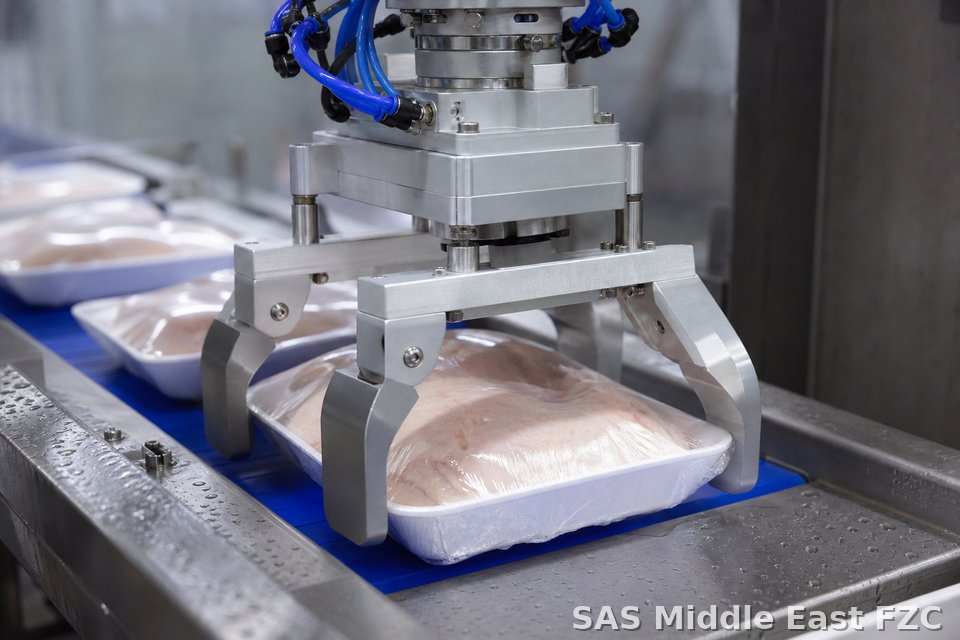
Food Processing
We engineer EOAT for pick-and-place, sorting and line feeding where product shape varies batch to batch. Layouts can use washdown-oriented materials, smooth surfaces and drainage paths where your specification requires it; soft compliant fingers handle wrapped goods, trays and irregular portions without over-constraining the robot path.
Multi-zone vacuum circuits, part-present sensing and defined blow-off sequences integrate with your existing PLC and robot safety logic. See also our AI Food Processing solutions for line data and quality layers above the tooling.
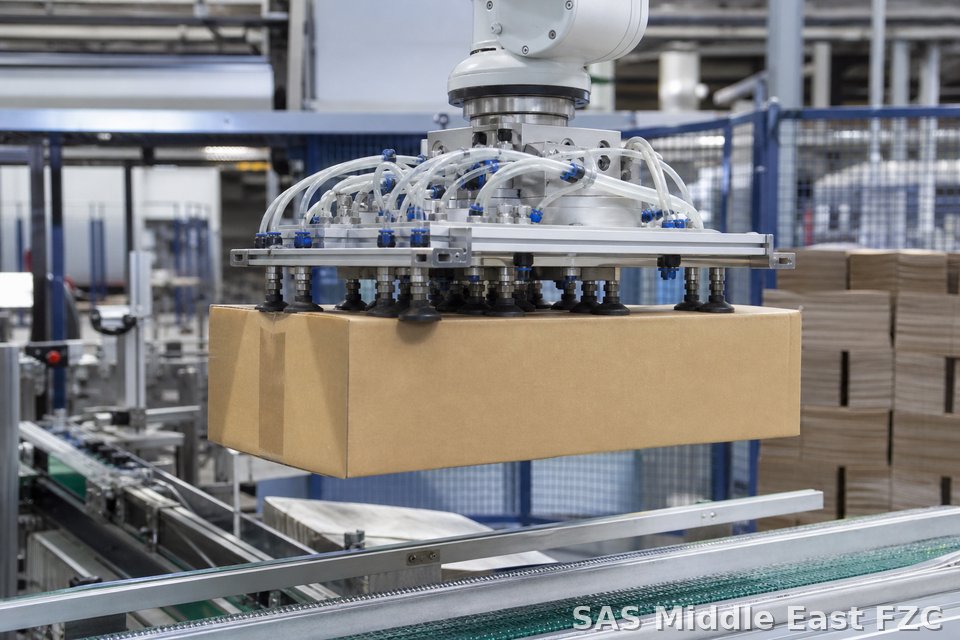
Packaging
Typical packaging EOAT includes carton and case handling, layer forming, conveyor pick-and-place and end-of-line palletizing. We design multi-cup vacuum arrays with zone switching so one tool can handle mixed patterns, and quick-change finger sets to shorten SKU changeover.
Mechanical design follows your cycle-time target and conveyor layout; FAT documents pick reliability, release timing and fault recovery before the tool ships. This pairs naturally with Application Engineering for full line integration.
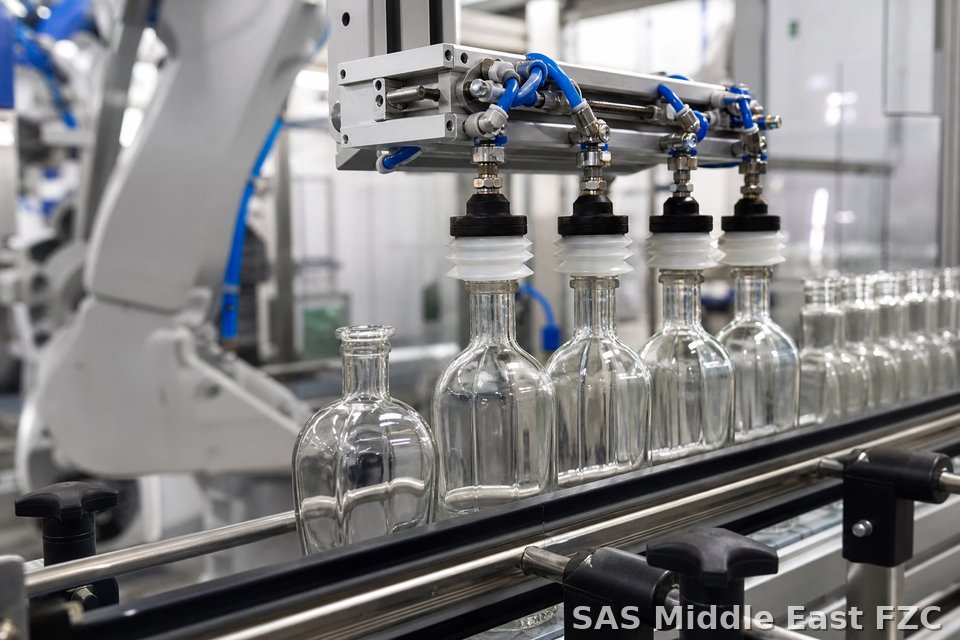
Glass
Glass and fragile sheet goods need controlled approach, compliant vacuum mounts and force-limited motion rather than rigid clamping. We engineer cup layouts with anti-mark materials, slow release profiles and nest or guide tooling for bottles, jars or flat panels — always matched to weight, coating and your allowed cycle time.
Handling strategy is validated in FAT with your sample parts; we do not assume one cup size fits every glass product. Where needed, we add compliance links or passive alignment features so minor position error does not transfer shock to the product.
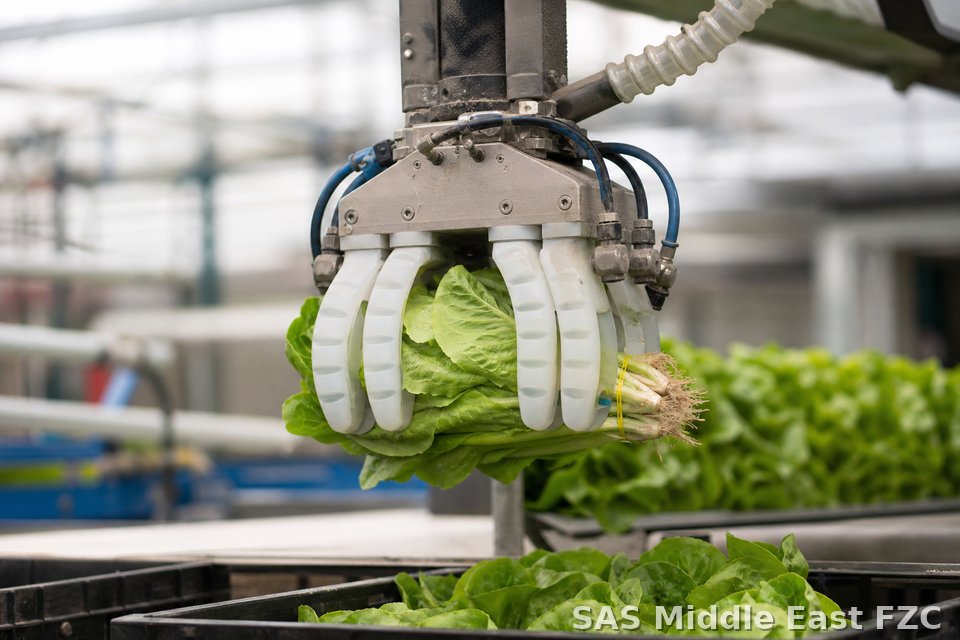
Agriculture & Turf
Agricultural and turf applications often involve irregular organic shapes, moisture and dust. We design gentle compliant grippers or vacuum tools with custom finger geometry for bundles, pots, trays or cut turf sections — balancing grip force against product bruising or deformation.
Pneumatic routing and materials are selected for the exposure level you describe (wash area, greenhouse humidity, outdoor loading). As with all SAS EOAT work, the tool is CAD-built, prototype-tested and handed over with documented acceptance criteria.
Typical Tooling Patterns
Representative engineering patterns — each build is specified for your line.
These are common EOAT configurations we design and manufacture as custom projects. Your tool may combine several of these elements.

Multi-zone vacuum EOAT
Independent vacuum circuits for secondary packaging lines where pattern or layer count changes with the product.
Interchangeable finger sets
Parallel-jaw gripper base with swap-in fingers for a family of SKUs on one robot station.
Compliant nest + vacuum
Guided nest with controlled vacuum release for fragile sheet goods, panels or glass products.
Tool changer plate
Quick-change interface so one robot can alternate between food, packaging or palletizing tools in a mixed cell.
Pilot gripper mechanisms are also developed in our R&D workshop (e.g. pneumatic palletizing prototypes) before production EOAT builds.
Design Considerations
What we define before metal is cut.
Delivery Process
From part data to production-ready EOAT.
Application Review
Part geometry, payload, cycle time, environment and robot model. We define gripping strategy, compliance needs and safety boundaries.
Mechanical Design
CAD layout, finger design, actuator selection, ISO 9409 flange adaptation and pneumatic/electrical interface to your cell.
Build & Prototype
In-house machining, 3D printing for prototypes, assembly, leak and function tests, then refinement from your feedback.
FAT & Handover
Documented acceptance tests, operator notes, spare-part list and optional on-site mounting with SAS robotics integration team.
FAQ
Questions plant engineers ask
Practical answers on EOAT — from Sharjah, for plants in the UAE and GCC.
Do you design and build custom EOAT in the UAE?
Yes. Grippers, vacuum tooling and quick-change systems are designed, built and FAT-tested for the robot and SKU family.
Is EOAT separate from robotics integration?
EOAT is the tool. Robotics integration is the cell, safety and programming. SAS delivers both together when the line needs a working cell.
Which industries?
Packaging, food, metals, logistics and general assembly — including mixed-SKU vacuum arrays and changeover finger sets.
Do you work on site in the UAE and GCC?
Yes. SAS Middle East FZC is based in Hamriyah Free Zone, Sharjah. We survey, engineer and commission EOAT on site across the UAE and GCC.
How do we request a technical proposal?
Use Request a technical proposal and include the machine, protocol or fault, and the site. We typically reply within 24 hours.
Need an answer for your site? Request a technical proposal — we typically reply within 24 hours.
Next Step
Tell us about your part and robot — we will propose the right EOAT.
Share part drawings or samples, robot make/model, payload, cycle time target and environment (clean room, wash-down, high temperature).